1Highlights
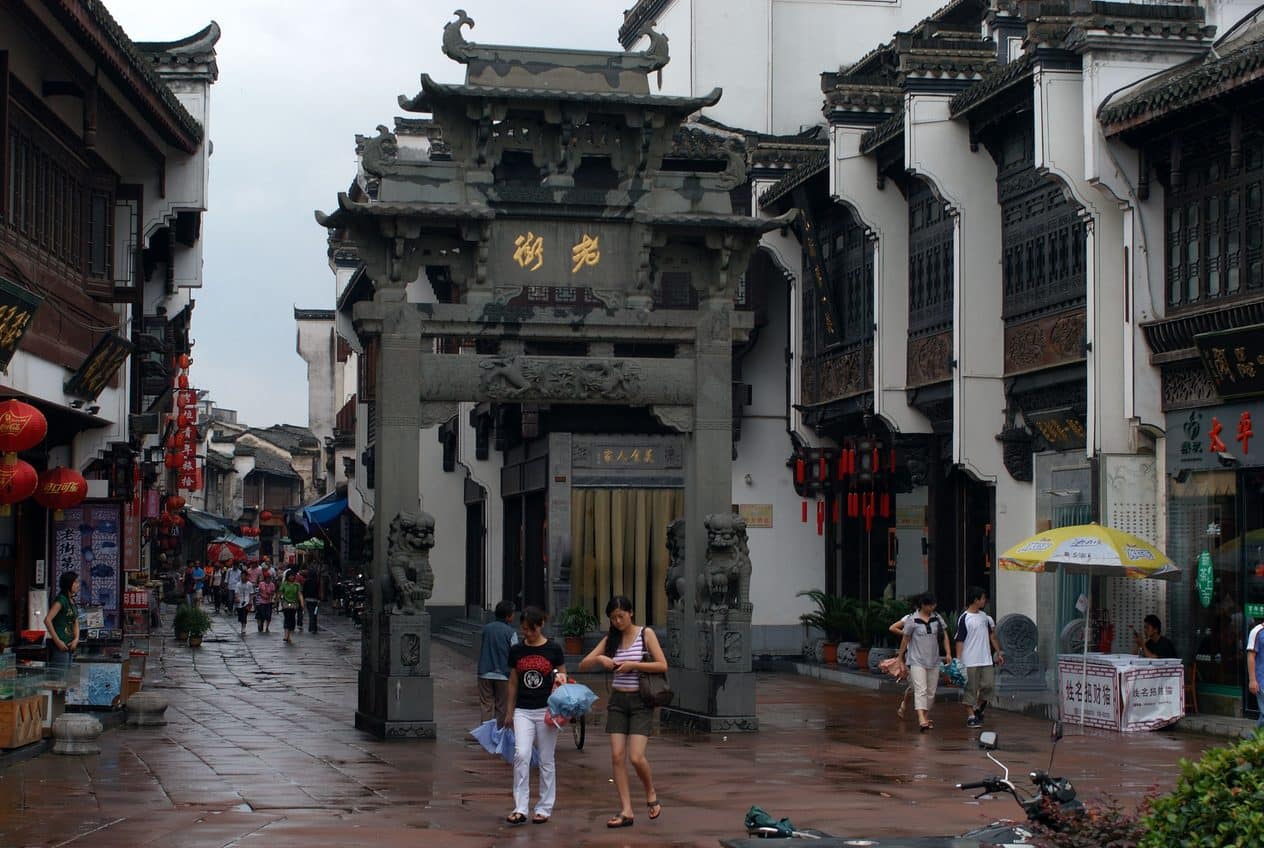
Tunxi Old Street runs through the middle of Huangshan city — the district is still called Tunxi, which is why the station, the airport and the street all share the name. It is a well-preserved Ming and Qing commercial street: timber shopfronts, Huizhou gables, flagstones, and shops selling the things this region has made for centuries — Hui ink and She inkstones, two of the 'four treasures of the study', and Huangshan Maofeng and Taiping Houkui tea. It is free, open all day, and sits twenty to thirty minutes from the high-speed station. Two honest observations about how to use it. First, it is at its best after dark: by day it reads as a commercial street, and once the lanterns come on and you walk through to the Xin'an River, it becomes the thing people remember. Second, and more practically — its real value on a Huizhou trip is logistical. Almost every coach you will take in this region is priced and timed from here or from the station twenty minutes away, which makes Tunxi the base that lets you do the mountain one day and the villages the next without repacking.
- Admission
- Free
- Street hours
- All day; shops roughly 09:00–22:00
- Location
- Tunxi district, Huangshan city
- Specialities
- Hui ink, She inkstones, Maofeng tea
- From Huangshan North
- 20–30 minutes by taxi
- To the mountain's South Gate
- About 1 hour
- Best time
- Dusk into the evening
- Suggested time
- About 2 hours
2Tickets
There is no ticket. The street and its lanes are free and open at any hour; individual shops keep their own times, generally opening around 09:00 and closing between 21:00 and 22:00. A handful of small exhibition halls along the street may charge their own admission, posted on site. Liyang In Lane across the bridge and the Xin'an riverside walkway are also free, and together they make the natural second half of an evening here. Since there is nothing to buy at a gate, the money you spend on this street is entirely in the shops — which is exactly why the two notes below are the useful part of this page.
| Tunxi Old Street | Free | Walkable at any hour. No ticket, no booking. |
|---|---|---|
| Shop hours | — | Roughly 09:00–22:00, varying by shop. Tea houses and ink shops tend to open later. |
| Small exhibition halls | Posted on site | A few charge separately. Optional in every case. |
| Liyang In Lane | Free | Across the bridge — a reworked old-and-new quarter, good after dark. |
| Xin'an riverside walkway | Free | The evening walk that makes the visit, with the street lit on the far bank. |
Buying tea: taste first, and ignore the adjectives:Huangshan Maofeng is priced by grade and picking date, and the spread between the cheapest and the dearest of the same name is enormous — which makes it the single easiest thing in this city to overpay for. The method is simple and shopkeepers expect it: ask to taste before you buy, compare two or three shops rather than the first one you walk into, and read the packaging for origin and production date rather than the marketing on the front. Terms like 'special reserve', 'tribute grade' or 'ancient tree' carry no defined meaning here and are reliably a premium you are paying for nothing. Buy a small quantity, drink it, and come back for more if it was good — the street is not going anywhere, and the shops ship.
Ink and inkstones: ask whether it is hand-carved or machined:Hui ink and She inkstones run from tens of yuan for a tourist piece to thousands for a maker's work, and the two can look similar across a glass counter. One question sorts most of it: is this hand-carved or machine-made? Follow it with whether the price includes the presentation box, which is sometimes a surprising fraction of the total. Keep the receipt for anything substantial. One more caveat worth having: 'old established' shop names are not evidence of anything — several shops on this street share near-identical names, so compare a few before committing. If you want to understand what you are buying rather than just buy it, several workshops here demonstrate ink-making and stone-carving on site, and watching for ten minutes is the most useful thing you can do before spending.
3Getting There
This is the part worth bookmarking. Tunxi is where the region's coach network converges, and the fares below are what actually gets quoted — which makes it easy to see why basing yourself here works.
20–30 minutes by taxi; local buses also pass nearby for about ¥2
15–20 minutes by taxi — the airport is inside the city
The coach you take to climb, about 1 hour
For the Taiping cable car side
About 1.5 hours; Xidi is ¥26 on the equivalent service
Useful if you go up one side and down the other
Base here, with one exception:Staying in Tunxi gives you a city with proper restaurants, reliable hotels at about ¥200–500 near the street and ¥150–350 near the station, an airport fifteen minutes away, and coaches to everything: the mountain's South Gate in about an hour, Hongcun and Xidi in about an hour each. You can do the mountain one day and the villages the next without moving hotels. The exception is a summit sunrise. If your plan involves being on a cable car at first light, sleeping in Tangkou at the South Gate — or on the mountain itself — saves you an hour of pre-dawn driving, and that hour is exactly the one you cannot make up. The sensible hybrid is Tunxi for the villages and the arrival and departure days, Tangkou or a summit hotel for the night that matters.
4Route & Photos
About two hours, and better after 17:00: west end of the street → the ink and inkstone workshops → a tea house, for tasting → hairy tofu and flatbread from the stalls → east end → across the bridge to Liyang In Lane → the Xin'an riverside for the lights.
This is the evening after the mountain, not a day of its own:Two hours is genuinely enough for the street, and trying to make a half-day of it will leave you walking past the same shopfronts twice. Where it fits perfectly is as the evening at the end of a hard day — you come off the mountain, clean up, eat properly, walk the street once with the lanterns on, and finish by the river. It is also the obvious place to do any buying, because the tea and ink shops here are better and better-priced than the equivalents inside the village gates, and you will not be carrying the purchases up several thousand steps.
Recommended Route
- 1
West end arch
The stone arch at the entrance. Start here and work east, which keeps the river at the far end as the finish.
- 2
Ink and inkstone shops
Several demonstrate ink-making and stone-carving on site. Ten minutes watching is worth more than any amount of browsing.
- 3
A tea house
Taste Maofeng and Taiping Houkui side by side before buying either. Comparison is the whole skill here.
- 4
The snack stalls
Hairy tofu griddled to order, and Huangshan flatbread — the local crab-shell-yellow kind, a couple of yuan each.
- 5
East end and across the bridge
Liyang In Lane on the far side, a reworked quarter of bars and cafés that fills up later than the street.
- 6
Xin'an riverside
The walk that ends the evening, with the old street lit across the water.
Best Photo Spots
Mid-street, with lanterns on
Timber shopfronts, flagstones and red lanterns in one receding line. Dusk, when the sky still has colour in it.
The street from the far bank
Lights doubled in the Xin'an River, with the bridge in frame. Worth the ten-minute walk across.
5Food & Stay
| Huizhou restaurants on and around the streetStinky mandarin fish, hairy tofu, one-pot layered stew | ¥60–120 pp | On-street places are pricier. Ask the price before ordering; the fish is sold by the piece or by weight. |
|---|---|---|
| The snack stallsHairy tofu, Huangshan flatbread, Huizhou pastries | ¥5–30 | Eat as you walk. Flatbread is a couple of yuan each; ten yuan is a filling breakfast. |
| Lanes off the main streetLocal Huizhou cooking | ¥40–70 pp | Where the city eats, one block back and noticeably cheaper than the street frontage. |
6Tips & Pitfalls
- Free, no booking, open all day. Shops run roughly 09:00–22:00, so the street has two quite different personalities.
- Come at dusk. By day it is a shopping street; once the lanterns are on and you walk through to the river, it is the thing people remember.
- Taste tea before buying, and buy small first. Maofeng is priced by grade and date; 'special reserve' and 'ancient tree' mean nothing definable.
- Ask whether ink and inkstones are hand-carved or machined, and whether the box is included. Keep receipts for anything substantial.
- 'Old established' means little here. Several shops share near-identical names — compare a few before you buy.
- Base in Tunxi for the villages, Tangkou for a summit sunrise. The street is 20–30 minutes from the station and about an hour from everything else; only a dawn start justifies sleeping closer to the mountain.
- Do your shopping here, not in the villages. Better range, better prices, and you are not carrying it up several thousand steps.
7Frequently Asked Questions
Does Tunxi Old Street charge admission?
No. The street and its lanes are free and walkable at any hour, with shops generally open from about 09:00 to between 21:00 and 22:00. A few small exhibition halls along the street may charge their own entry, posted on site.
When is the best time to go?
Dusk into the evening. By day the street reads as commercial; after dark the lanterns come on, the stalls get going, and the walk continues across the bridge to Liyang In Lane and along the Xin'an River, which is the better half of the visit. Two hours covers it comfortably.
What should I buy here, and how do I avoid overpaying?
Huangshan Maofeng and Taiping Houkui tea, and Hui ink and She inkstones. For tea: taste before buying, compare two or three shops, read the packaging for origin and production date, and treat terms like 'special reserve' or 'ancient tree' as marketing. For ink and stones: ask directly whether the piece is hand-carved or machine-made and whether the box is included, since the price range is enormous. Keep receipts for anything substantial.
How do I get there from Huangshan North station?
Twenty to thirty minutes by taxi for about ¥30–50, or local buses that pass nearby for about ¥2. From Huangshan Tunxi airport it is fifteen to twenty minutes, since the airport is inside the city.
Should I stay in Tunxi?
As a base for the region, yes — hotels near the street run about ¥200–500 and near the station about ¥150–350, the airport is fifteen minutes away, and coaches reach the mountain's South Gate in about an hour and Hongcun and Xidi in about an hour each, so you can do the mountain one day and the villages the next without changing hotels. The one exception is a summit sunrise: for that, sleep in Tangkou at the South Gate or on the mountain itself, because the hour of pre-dawn driving is the hour you cannot recover.
Combine With
Other Huangshan sights that genuinely pair well with this one
Before You Go
The practical guides you will actually need here
All Huangshan attractions
Saily
eSIM by the team behind NordVPN
Saily is a newer travel eSIM from the NordVPN team, which brings a privacy-first approach to the eSIM space. China plans route through an overseas gateway so blocked sites work without a VPN. The app is clean and simple, and plans are competitively priced. A good option if you already use NordVPN products or want a privacy-focused eSIM.
- Built by the NordVPN team — privacy-first infrastructure
- Overseas gateway means blocked sites work without VPN
- Clean, simple app with easy setup
- Competitive pricing for China plans
Disclosure: this is an affiliate link. We may earn a small commission if you buy through it, at no extra cost to you. We only recommend products we would use ourselves.
GoChinaTravel Editorial Team
Our team of China travel researchers combines on-the-ground contributor insights, official government sources, and traveler community feedback to create the most detailed English-language China guides available. Every guide is fact-checked against primary sources (NIA, 12367, official attraction websites, Railway 12306) before publication.